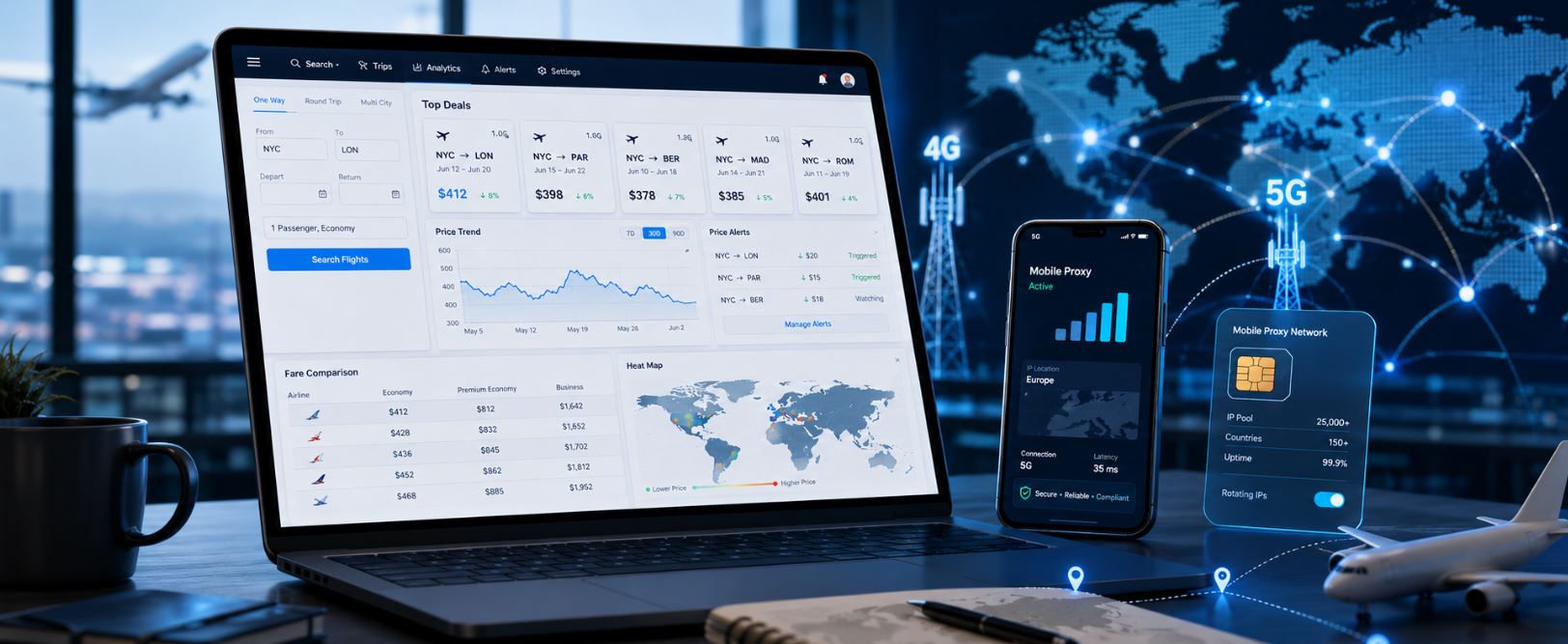
Flight scraping is not used only by large travel platforms. Smaller agencies, analytics teams, marketers, SEO specialists, and travel product owners also need to understand real price dynamics: when a route becomes more expensive, which airlines offer better fares, and how the final price changes by country, currency, departure date, and sales channel. The challenge is that the airline market is sensitive to request volume, request geography, and traffic quality. This is why mobile proxies for flight scraping are often treated as a separate operational tool, not just a minor technical setting.
It is important to separate two very different approaches. The first is legitimate monitoring of public data: comparing open fares, checking localization, testing your own product, and tracking prices within the rules of the source. The second is aggressive data collection that ignores website terms, tries to bypass protection, creates excessive load, or uses accounts without permission. This article covers only the first scenario. Mobile proxies for flight scraping make sense when you collect open information carefully, with rate limits, activity logs, and respect for the rules of each website.
What flight scraping means and what data is usually collected
Flight scraping is the automated collection of structured data from public pages, APIs, or authorized partner integrations. In practice, it is not about breaking into a website. It is about turning search results into a dataset that can be analyzed. For example, a service may check the route Kyiv — Warsaw, Chisinau — London, or Bucharest — Paris every few hours and store the lowest price, airline, stops, baggage rules, currency, search date, and source.
The most common fields include:
- departure and arrival city or airport;
- departure date, return date, and trip duration;
- price, currency, taxes, and service fees;
- airline, flight number, and number of stops;
- baggage conditions, cabin class, and fare flexibility;
- data source: airline website, aggregator, or partner API;
- request geo, interface language, check time, and response status.
This data is useful for demand analysis, fare window detection, offer validation, alerts, competitor monitoring, and content such as “when is it cheaper to fly to Istanbul.” But the value depends on the quality of collection. If some requests return cached results, others return errors, and others show prices in the wrong currency, the analytics will quickly become unreliable.
Why flight prices may vary by geography
Users often notice that the same route can appear with a different currency, language, seller list, or even final price in different countries. The reason is not always personal tracking. In travel distribution, prices can be affected by sales channels, local fees, partner agreements, seat availability, payment method, currency, point of sale, and the rules of the specific seller. This means flight price scraping without geographic control gives an incomplete picture.
For example, a travel website may show users in Poland prices in Polish zloty and highlight one group of agents, while users in Moldova may see another seller list and another currency. This matters for businesses operating in several markets or testing localized landing pages. Mobile proxies for price monitoring help verify what a real user from the target market sees, not only what an office server in a data center sees.
Why mobile proxies are used for flight scraping
A mobile proxy routes internet access through the IP address of a mobile operator. To websites, this traffic is closer to a normal smartphone or mobile internet user than traffic from a data center. This does not mean that a mobile IP gives permission to ignore website rules. Its role is different: to check geography more accurately, reduce distortions caused by server IPs, distribute technical load, and make monitoring more stable.
In flight data tasks, mobile proxies are useful in several cases:
- Geo checks. You can compare how a price appears to a user in Ukraine, Poland, Moldova, Romania, Kazakhstan, or another country.
- Localization. You can check language, currency, local agencies, payment hints, and route availability.
- Data quality. Some websites treat data-center traffic differently, so results from a server IP may not match real user output.
- Request distribution. If monitoring covers many routes, requests should be spread over time and across lawful access points.
- Travel product QA. Teams can verify their own pages, redirects, affiliate links, and fare display from different countries.
This is why the query “mobile proxies for flight scraping” usually appears when a team needs more than a single page load. It is relevant when there is a systematic need to monitor routes, dates, and local search results.
Mobile, residential, and data-center proxies: which one fits travel data
Different proxy types can be used for flight scraping, and each one has limitations. Data-center proxies are cheaper and faster, but their IP ranges are often well known to large platforms. They are suitable for owned websites, APIs, test environments, and tasks where geographic realism is not critical.
Residential proxies route traffic through fixed consumer internet connections. They can help with local checks, but quality depends heavily on the provider, the transparency of IP sourcing, and session stability. For travel projects, it is not enough to have an IP from the right country. You also need to know how predictable the connection is.
Mobile proxies work through mobile operators. Their advantage is a natural mobile traffic profile, real carrier IP pools, and the ability to test mobile scenarios. Their downside is that speed is less predictable than in a data center, IPs may change after reconnection, and sessions need careful configuration. For flight price scraping, this is acceptable if the system does not generate thousands of aggressive requests and instead behaves like controlled monitoring.
The legal framework: what to do and what to avoid
Before collecting data, check three things: the website’s terms of use, robots.txt, and available official APIs. In the travel industry, there are standardized approaches to data exchange, including NDC, and some aggregators provide partner APIs for flight search. If an API gives you the data you need, start there. Scraping should be reserved for tasks that official access does not cover: QA, local search result verification, comparison of public pages, and fare display audits.
A safer approach to flight scraping should include the following:
- collect only public, non-personal data;
- do not access private accounts without permission;
- do not collect passenger personal data, payment information, or private profiles;
- do not ignore disallowed areas in robots.txt;
- do not try to break CAPTCHA, WAF, login, or other technical barriers;
- respect rate limits, pauses, and headers such as Retry-After;
- keep a log of sources, time, response status, and collection purpose;
- delete data that is not required for your business objective.
If a website clearly prohibits automated access or returns 403, 429, or a CAPTCHA, this should not be treated as a signal to hide harder. It is a signal to reduce frequency, change the source, request API access, or get permission. This approach is better for long-term business and safer for advertising, partnerships, and reputation.
How to build a flight fare monitoring system
A proper system starts not with proxies, but with a data map. First, define which routes, dates, countries, and sources are actually needed. If a business sells flights for Ukraine, Moldova, and Poland, there is no reason to check hundreds of routes in every country every minute. A better approach is a priority matrix: top routes, seasonal destinations, high-demand dates, and several control dates in the future.
1. Sources and permissions
For each source, document whether an API exists, whether automated access is allowed, which pages are public, what restrictions are listed in the rules, and whether results may be stored. This may look boring, but it is what separates operational analytics from risky data collection.
2. Search scenario
The request should look like a normal price check: route, date, number of passengers, cabin class, language, and currency. Avoid endless combinations with no business logic. Checking one route every 3–6 hours is a very different load profile from sending hundreds of requests per minute.
3. Geo and mobile sessions
Mobile proxies should be tied to a specific country and scenario. For example, one profile checks Poland in Polish and zloty, another checks Moldova in Romanian or Russian, and a third checks Ukraine in Ukrainian. This makes the data easier to compare. IP rotation should not happen after every click. For travel websites, a short sticky session is often more stable, because several steps of a search are completed through the same connection.
4. Frequency and backoff
The system should include pauses, caching, and error handling. If a source responds slowly, returns 429, or asks the client to retry later, the collector should not keep pushing. It is better to reduce frequency, place the route back into the queue, and retry later. This lowers the risk of blocking and improves data quality.
5. Data normalization
Prices from different sources must be converted into a consistent format. Do not mix base fare with final price including baggage. Do not compare different currencies without using the exchange rate at the time of collection. Do not ignore agent fees. The dataset should include separate fields for timestamp, source, geo, currency, fare type, and whether the price was confirmed at the next step.
Practical use cases
Competitive fare monitoring. An agency wants to know whether its offers are falling behind the market. It checks 20–50 key routes several times a day and receives alerts when the gap exceeds a defined threshold.
Fare window detection. A travel content website builds a history of minimum fares and publishes guides about cheaper periods for popular destinations. In this case, clean historical data matters more than speed.
Localization QA. A team checks whether the website opens correctly for users from different countries: language, currency, route availability, partner redirect, UTM tags, and final booking page.
Affiliate link checks. If a business earns through an affiliate model, it needs to verify that the path from the fare page to the seller does not break. Mobile proxies help check the result not only from an office IP, but also from a mobile connection in the target market.
Common mistakes in flight scraping
The first mistake is excessive frequency. If the system behaves like a stress test, it harms the source and receives worse data. The second is missing geo control. Without storing country, language, and currency, it is impossible to understand why a price differs. The third is mixing fare types: cabin baggage, checked baggage, refunds, seat selection, and service fees can completely change the conclusion.
The fourth mistake is expecting proxies to solve everything. If the collection logic is poor, a mobile IP will not fix it. You still need limits, caching, error handling, normalization, and respect for site rules. The fifth mistake is skipping legal review. Even if the data is public, personal data, commercial terms, databases, or content may have separate usage restrictions.
How to choose mobile proxies for flight fare monitoring
For this task, country and price are not the only factors that matter. Look at session stability, carrier selection, HTTP(S) and SOCKS5 support, response speed, a clear IP change mechanism, transparent limits, and support quality. If you need to check mobile search results in a specific country, it is better to use a dedicated proxy for that market rather than a random mixed pool.
It is also useful to define success in advance. For analytics, it is enough to receive most scheduled responses consistently. For QA, screenshots, redirects, and the full page sequence may be important. For a content project, historical price series, correct geo, currency, and deduplication matter more. Different goals require different mobile proxy settings.
If you need to check flight prices from different geographies, it is important to use not a random proxy, but a stable mobile channel with a clear country, carrier, and the ability to test it before payment. For example, ProxyCola offers mobile proxies in more than 15 countries, including Ukraine, Moldova, Poland, Kazakhstan, Romania, and other markets.
For price monitoring, travel service QA, and local search result checks, you can use HTTP(S) or SOCKS5, choose the required country, and test how a website displays fares for a user from a specific market. After registration, a free 2-hour test is available, so you can check speed, stability, and whether the proxy fits your scenario.
If your main focus is Ukrainian mobile traffic, you can also check TurboProxy. It is a separate option for tasks where you need mobile proxies from Ukraine: checking local search results, Ukrainian prices, page availability, redirects, and travel service behavior for users with Ukrainian mobile IPs.
Mobile proxies for flight scraping and fare monitoring: when they actually make sense
Mobile proxies for flight scraping are useful for lawful geo monitoring, local fare checks, and QA of travel products. They help you see the market through the eyes of a user in a specific country, but they do not replace website rules or data laws.
The best strategy is to check official APIs and access terms first, then build a limited route matrix, configure pauses, caching, and normalization, and only then use mobile proxies where they bring clear value. With this approach, flight price scraping becomes a controlled business intelligence system rather than a risky race for data: transparent sources, clear frequency, correct geo context, and results that can be trusted.